

Confused about whether PRS and PPL are legal requirements for your business? This guide will help you understand who they are and if you need to pay them to play music.
Who are PRS and PPL?
PRS and PPL are both organisations that collect royalties for the use of music in public via music licensing. Both are required if you are playing music in your business; however, they are separate organisations.
The Difference Between PRS and PPL
Whilst they both license the use of music and collect royalties, they represent different rightsholders. They have separate tariffs, terms and conditions.

PRS (Performing Rights Society) collects royalties for songwriters, composers, and music publishers.
PPL (Phonographic Performance Limited) collects royalties for record labels and performers.
They work together to operate TheMusicLicence. If you are playing music in your business for staff and/or customers. This is the license you need to do so legally.
The cost of your PRS PPL music licence will depend on…
- The type of business you have.
- The audible area size.
- And in the case of restaurants/cafes and coffee shops, the number of seats you have.
Is PRS PPL a Legal Requirement?
If you’re playing music in your business for example via TV, CD, radio or streaming service. You have a legal obligation to purchase a music license from PRS PPL.
This is because The Copyright, Design and Patents Act 1998 states you must obtain the copyright holder’s permission to use their music in your business. A PRS PPL music license grants you this permission.
The exception is if you are playing royalty-free music as PRS and PPL do not collect royalties for this music. Many business owners choose to play royalty-free music as a way to save money. It is considerably cheaper for most types of businesses. You can find out more about doing that here.
What Happens if You Don’t Have a PRS PPL Licence?
If you are playing music in your business without a music license, you are infringing copyright, as you do not have the owner’s permission to do so. Fines can be issued and court proceedings can take place.
Both PRS and PPL are very proactive in checking that business owners are playing music legally. If you are found to be playing music without a license and you will be invoiced. You can expect your invoice to cover the backdated period you have played music without a license and the year ahead at a higher rate for the license. This is the standard rate plus 50%.
Is PRS PPL legally enforceable? Here’s a statement from the gov.uk website on copyright infringement.
“You’re infringing copyright if you play live or recorded music in public without a licence. You could be sued for damages.”
Is There an Alternative?
Royalty-free music is a legal alternative to paying PRS PPL as they do not collect royalty payments for this type of music. Instead, a music licensing company collects them.
Whilst decent royalty-free music is not ‘free’, it is a considerably cheaper way to play music than a music license. Read more about playing royalty-free music in your business here.
Background Sounds Royalty-Free Music Service
UK businesses trust us every day to supply their royalty-free music. With over 60 playlists available for streaming via your PC, laptop, mobile or tablet, setup is quick and easy; the hard part is choosing your playlist!
Best of all, we offer a free, no-obligation trial of our service. You get full access to our playlists, and we’re on hand if you need support.
There are no card details to add, making it a risk-free way to try royalty-free music in your business.
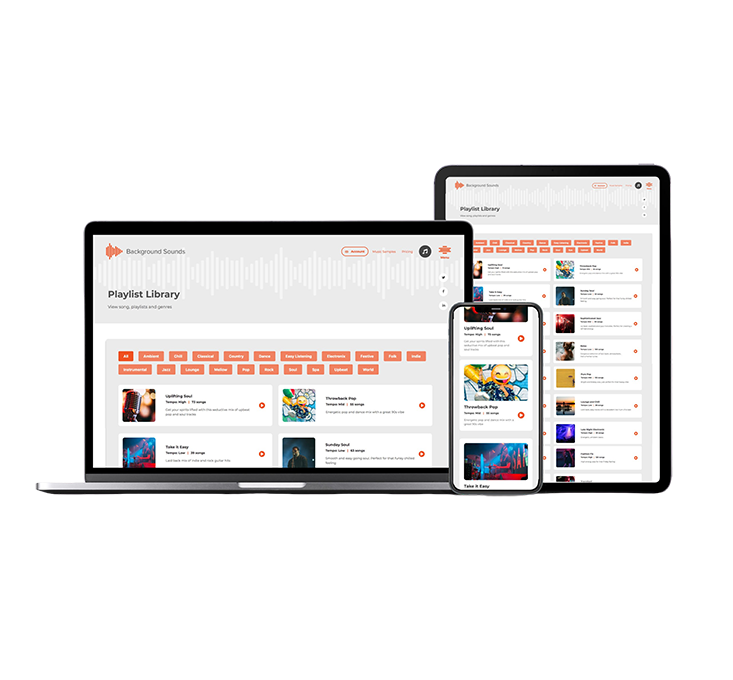
Find out more about using our service to stream royalty-free music and take a FREE TRIAL here
Background Sounds is a specialist provider of royalty-free music based in the UK. Working with business owners who want to play music without the need to buy a Music Licence.
You can access the service via online streaming with a subscription to Background Sounds. You can find out all you need to know on our home page here.
