

The music playing in your business is doing more than filling the silence. It shapes how your customers feel from the moment they walk through the door, influencing how long they stay, how much they spend, and whether they come back. For your staff, it affects energy levels, morale and the quality of service they deliver throughout the day.
Getting it right does not need to be complicated. Whether you own a shop, restaurant, coffee shop, café or hair salon, these five practical tips will help you choose background music that works hard for your type of business.
Key Takeaways
- Slow music increases retail sales volume by an average of 38% and spend by 40% per visit.
- 79% of employees would benefit from listening to music at work. 59% say it improves their wellbeing.
- The right background music increases customer dwell time, spending and staff morale.
- The five factors that matter most: genre, volume, tempo, variety, and freshness.
- Playing music commercially requires a music licence from PRS PPL unless you use a royalty-free service.
How to Make Your Background Music Work for You

1. Genre – Match Your Music to Your Brand
Consistency is key to a great customer experience and ultimately spending. Your customer will be constantly taking in (consciously and unconsciously) cues and signals about your business, and this will inform their behaviour.
When your background music aligns with your brand, pricing and visual merchandising, customers will feel more relaxed due to the consistency of the environment. This feeling will encourage them to browse longer, which in turn can lead to more sales.
Here’s how to match your background music to your brand in three easy steps.
Step 1. Write down all the words you would use to describe your brand. For example, cheerful, fun, relaxed, young, expensive, exclusive.
Step 2. You can then match this list to music genres you would describe in the same way, e.g. pop (mid-tempo) is fun and cheerful. Classical music is usually described as elegant and high-class.
Step 3. Build your playlist based on a mix of the genres you have listed. Keep it under review for a little while, too.
TOP TIP. Short on time? Use the sector and mood tabs at the top of the Background Sounds royalty-free playlist library to filter our top playlist recommendations for your business.
2. Volume – Give it Attention
The volume of your background music is a key factor in how your customers will react. Too loud, and customers feel uncomfortable and leave. Too quiet and the music provides no atmosphere, leaving the room feeling flat. Think background, not foreground.
A good rule of thumb is that your music should be loud enough to notice but low enough that customers can hold a conversation without raising their voices. Lower-volume music encourages more relaxed purchasing decisions, whilst a high volume increases arousal and urgency.
A free decibel meter app, available on both iPhone and Android can help you find the right level for your environment.
Top Tip. Before opening up, take two minutes to walk around your business and check how the volume feels in different areas. Poor speaker placement can result in volume hot spots, making your customers uncomfortable. A quick volume change or speaker move can make all the difference!

3. Tempo – Set the Right Pace
Tempo (how fast the beat of your music is) can influence how quickly your customers move. So it’s important to think about how long you want your customers to browse or dine.
If you want them to linger and take their time, which can increase shopper spending, we suggest a lower-tempo playlist.
In contrast, if you want your customers in and out quickly, perhaps at closing time, a higher tempo will help you achieve this.
In one of the most cited studies in retail research, Professor Ronald E. Milliman examined the effect of music tempo on shopping behaviour across nine weeks in a supermarket environment. He found…
- Shoppers moved noticeably faster when fast-tempo music was playing, reducing browsing time and impulse purchases.
- Shoppers slowed down under slow-tempo music, increasing dwell time and the volume of purchases made.
- Retail sales volume was, on average, 38% higher on days when slow-tempo music was played.

4. Add Variety – Reflect Customer Mood
Do you notice a shift in your customers’ attitude or demeanour on different days of the week? Are they more relaxed on a weekend? Jump on this and switch up your background music. Having 2-3 playlists ready makes it easy to vary your background music across the week. You may want to consider…
- A softer, lower-tempo playlist for quieter midweek mornings.
- Something more upbeat and energetic for busy lunch periods and weekends.
- A warmer, more relaxed selection for late afternoon and evening where relevant.
A variety of playlists also benefits your team. Playing the same music on repeat every day is a fast route to your background music becoming noise that no longer creates atmosphere, and that your staff begins to tune out of entirely.

5. Keep it Fresh – Motivate With Music
Music is a huge motivator. Use your background music to boost your employees’ mood and motivation levels whilst also improving your customers’ experience and creating a more positive atmosphere.
In retail and hospitality environments, where staff are on their feet for long shifts and required to maintain consistent energy with customers, the right music can have a big impact.
Studies have shown…
- 79% of employees would benefit from listening to music at work (Totaljobs 2016).
- 59% say music improves their psychological well-being (Totaljobs 2016).
- 81% of participants worked faster when music was playing (Mindlab 2014).
Keeping your music fresh by rotating playlists regularly and varying your selection across the week ensures your music continues to do its job: creating atmosphere for customers and genuine motivation for your team.
Are You Playing Music Legally?
Lastly, and most importantly, ensure you are playing music in your business legally. This means that if you are playing commercial music via a radio, CD or streaming service (or if you use a TV), you have a music licence issued by PRS and PPL here in the UK.
In the UK, under the Copyright, Designs and Patents Act (1988), business owners require the copyright holder’s permission to play their music in the business. When you purchase a music licence, this is granted to you by PRS and PPL on behalf of the copyright holders.
The exception is royalty-free music; when playing this, business owners do not require a music licence from PRS/PPL because the copyright holders are not registered with them. Instead, they are paid for the use of their work via a music licensing company.
If you’re unsure what that means for your specific business, our guide to whether you need a music licence covers it in full here.
How Much Could You Save Switching to Royalty-Free Music?
Here at Background Sounds, we specialise in supplying high-quality royalty-free music to businesses across the UK. We offer a simple, straightforward pricing model and typically save businesses 60-70% on the cost of paying for a music licence.
Our annual subscription is £150 + VAT per year. Monthly subscriptions are available at £15 + VAT per month. Both plans are a flat fee per site and the same price regardless of your business type, size or number of seats.

We have two subscription packages, both of which offer the same great service; the only difference is how you pay.
Ready to Make Your Music Work Harder for Your Business?
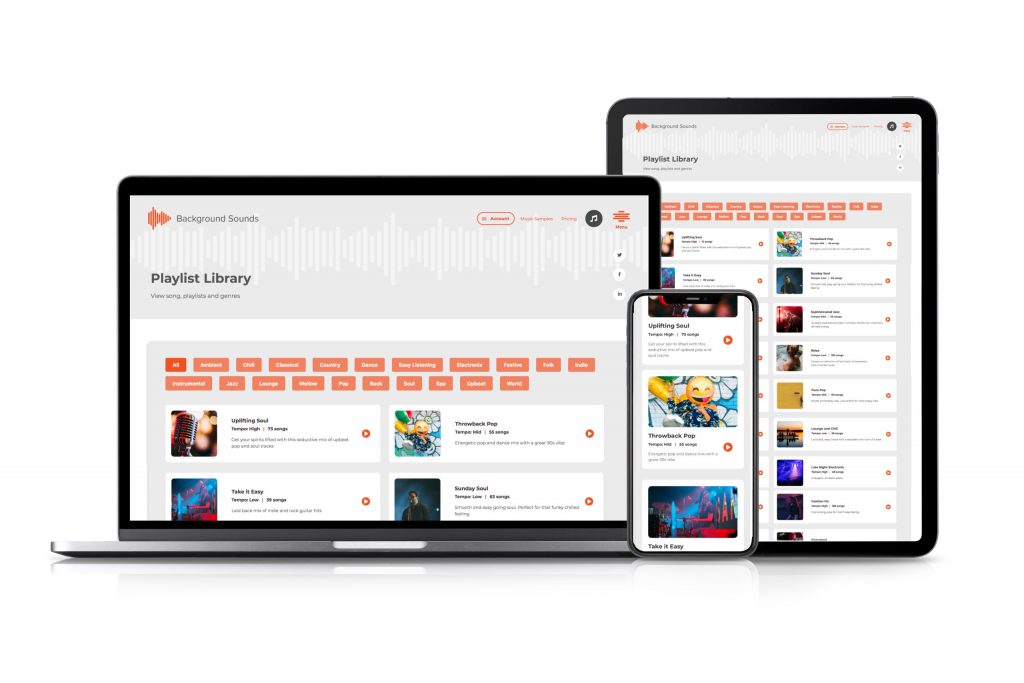
Background Sounds gives you access to over 70 professionally curated playlists across more than 20 genres, with new music added to our library every month. Every playlist is curated by expert music profilers specifically for commercial environments.
- Over 70 playlists covering more than 20 genres
- A certificate of subscription is issued automatically to all paid members
- Stream from any device, so no specialist equipment needed
Start your free trial today! Sign up here.
Frequently Asked Questions
What volume should background music be in a shop or cafe?
As a general guide, your music should be loud enough to create atmosphere without making conversation difficult. Think background, not foreground, when selecting the volume for your music. A free decibel meter app can help you find the right level for your environment.
Should background music be different on different days of the week?
Yes, customer energy shifts predictably across the week: Monday mornings are quieter and more focused, Friday afternoons and weekends are more relaxed and social. Matching your playlist to those shifts reinforces the mood your customers are already in. Two or three playlists that you can switch between are all you need.
Does background music affect staff as well as customers?
Yes, and in retail and hospitality, that will directly translate to better customer service.
Research by Totaljobs and music psychologist Dr Anneli Haake, across 4,500+ UK workers, found that 79% of employees would benefit from listening to music at work and 59% say it improves their wellbeing. Mindlab International found that 81% of participants worked faster when music was playing.
Do I need a music licence to play background music in my business?
Yes, if you are playing mainstream commercial music (via Spotify, Apple Music, radio, CDs, or even using the TV), you need to buy a music licence from PRS and PPL. If you use a royalty-free music service like Background Sounds, you have no PRS PPL obligation, so you do not need a music licence.
For a full breakdown of what music you can play without a licence in the UK, including the difference between PRS and PPL, read our complete guide here.
About Background Sounds
Background Sounds supplies royalty-free background music to businesses across the UK, helping them create the right atmosphere without the need for a PRS or PPL music licence. The service is offered via online streaming, and you can find out all you need to know on our home page here.
References
This post was originally published in 2022 and was last updated in July 2026
